Several weeks ahead
A plan over at least four weeks, then replanning on the week or the day.
Describe how your foundry really works, in words. FIP turns rules and constraints into a feasible production plan and tells you clearly what does not fit, and why.
In short
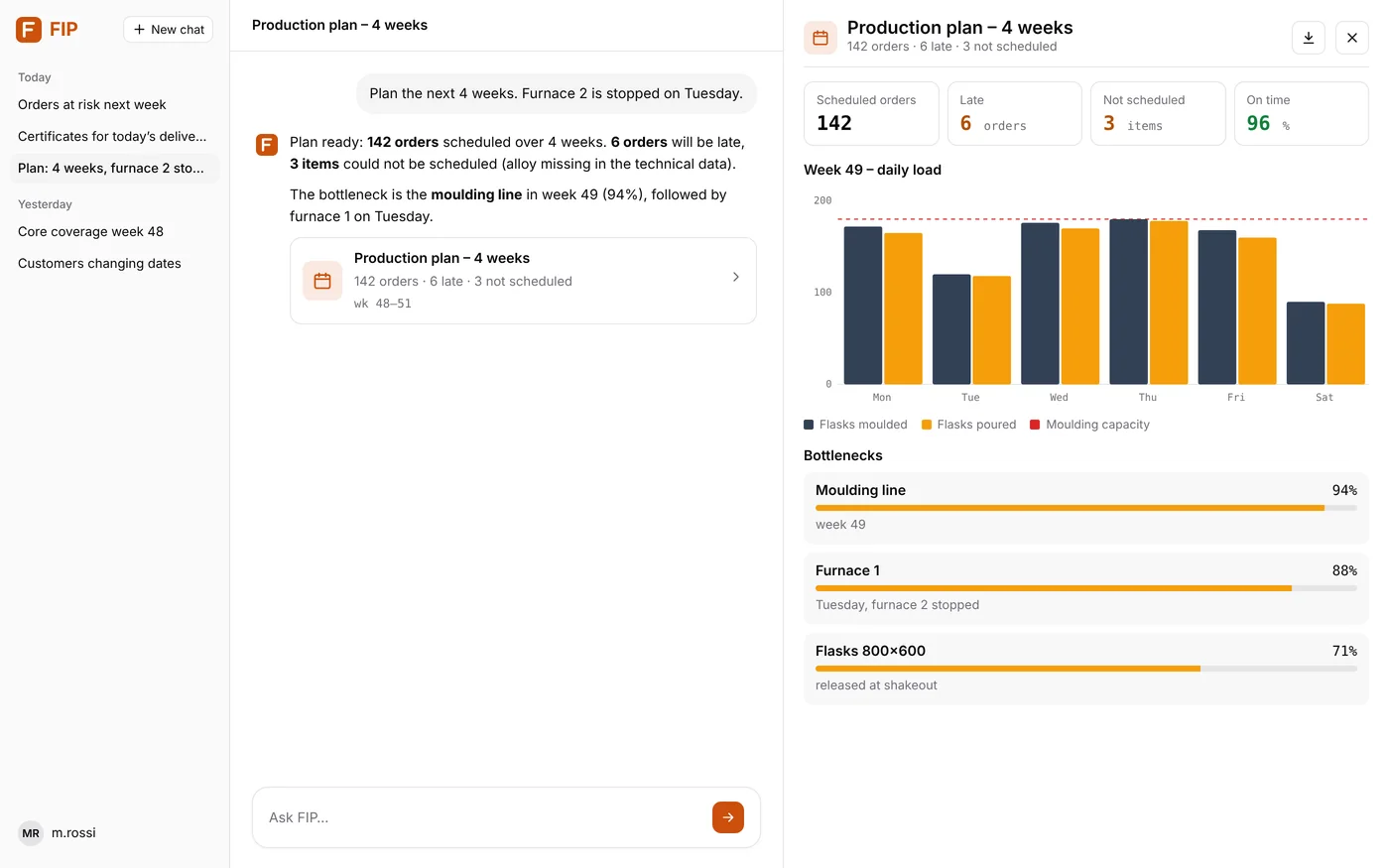
FIP schedules foundry production from moulding to pouring with an optimisation engine. Constraints are described in plain language: moulding capacity, stations, furnaces, kg per heat, alloys, shifts, shared patterns and limited flasks. The plan covers several weeks, includes late orders and always explains delays, unscheduled items and bottlenecks.
In a foundry, capacity is not just hours of work. Moulding and pouring are linked, the furnace cannot pour below its minimum, alloys cannot be mixed in the same heat, patterns are shared between items and flasks are a limited resource that returns only after shakeout.
Generic scheduling tools struggle with these rules. FIP was designed around them.
A plan is useful only if you understand it. FIP always tells you what stays behind, what could not be scheduled and why, which resource is the bottleneck and how saturated it is. Orders already late are included in the plan from the first day.
A plan over at least four weeks, then replanning on the week or the day.
Saturation of moulding, furnaces and flasks, day by day.
“What if we add a heat on Saturday?” FIP recalculates with the new rule.
When something changes, you do not need to reconfigure anything. Tell FIP: “furnace 2 is stopped on Tuesday”, “give priority to customer X”, “add a shift on the moulding line”. FIP creates a temporary plan with the new rules, compares it with the main one and shows you the difference.
The main rules of the foundry are described once, in words, and saved. Every planner can then work with the same rules.
No. The constraints are described in plain language, for example “the moulding line makes at most 180 flasks a day” or “furnace 1 pours at least 900 kg per heat”. FIP translates them into scheduling rules.
It is designed to adapt to different foundries: manual or automatic moulding, one or more furnaces, ferrous and non-ferrous alloys. The rules describe your plant, not a standard model.
No. It gives the planner a feasible plan in minutes and explains the critical points. Decisions stay with people, who can change the rules and recalculate at any time.
Ask about orders, production, cores, warehouse and quality in plain language. FIP answers with data, tables, charts and PDF reports, without queries.
Learn more →FIP analyses stock movements, cores against the production programme and the history of customer orders to find anomalies, causes and customers who change plans.
Learn more →How production, planning, quality, sales, purchasing and management use FIP every day: concrete questions and results for each role in the foundry.
Learn more →Start with FIP from a concrete problem of your foundry: a pilot project on your data, with measurable goals, to see the results of AI before extending it.
Learn more →Tell us about it. We will solve it together with a pilot project on your data, with measurable goals.