Artificial intelligence for foundries
FIP is an AI platform built specifically for foundries. It works on your ERP data and on the real processes of a foundry: orders, moulding, cores, melting, quality, warehouse and costs.
In short
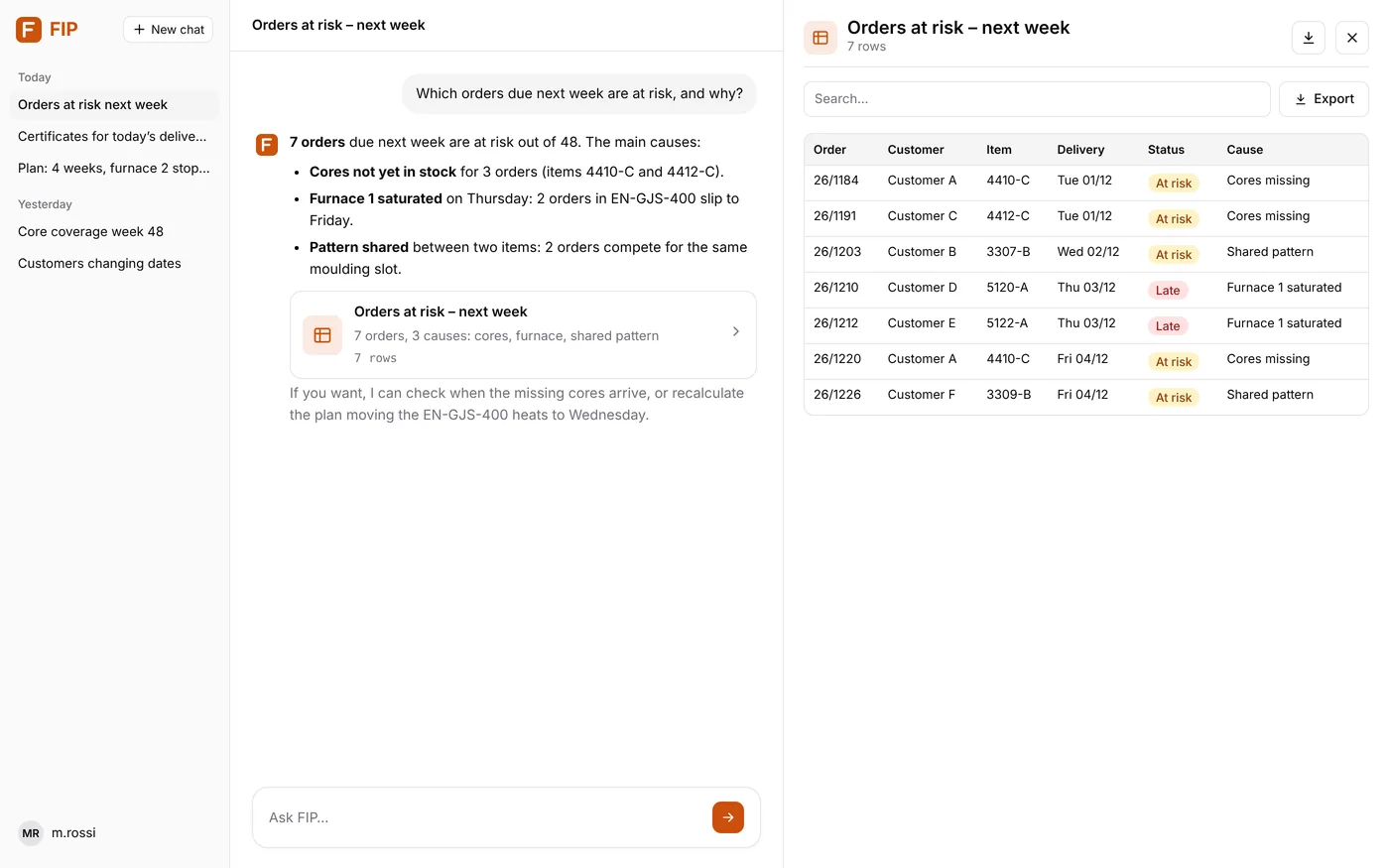
FIP (Foundry Intelligence Platform) is a team of specialised AI agents for foundries. It answers questions in plain language on ERP data, schedules production with constraints described in words, generates material certificates on customer templates, finds anomalies and learns from daily use.
Why a foundry needs AI built for foundries
Generic AI assistants know language, not foundries. They do not know what a heat, a flask, a core box or a melting loss is, and they cannot read your ERP data safely.
FIP starts from the opposite side: it knows the vocabulary and the processes of the foundry, it reads data through controlled services, and it is designed to give answers that a production manager can use straight away.
What FIP does
Questions in plain language on ERP data
Orders, production, cores, warehouse, quality and costs: ask as you would ask a colleague.
Learn more →AI production scheduling
Describe constraints in words and get a feasible plan, with delays and bottlenecks explained.
Learn more →Automatic material certificates
Certificates generated from delivery notes, on your templates or on the customer’s own files.
Learn more →Anomalies, warehouse and orders
Stock movements, period comparisons, order changes and early warnings on what is out of line.
Learn more →Self-learning
FIP improves with use: it learns your language and creates new analyses when needed.
Learn more →Reports and documents
PDF reports and documents on request, sent by email and ready to share.
Learn more →Who uses it in the foundry
FIP is designed for the people who make decisions every day: production and planning managers, quality managers, sales and customer service, purchasing and warehouse, management. Each one asks questions about their own area, without learning a new piece of software.
- Production manager: what is late, what is missing, what to move.
- Quality manager: certificates, tests, non-conformities.
- Sales: delivery dates that can really be promised.
- Management: trends, margins and critical customers.
How it differs from a dashboard
A dashboard shows the indicators someone decided in advance. FIP answers the question you have now, even if nobody foresaw it, and explains the result in words.
When the same question comes back often, FIP learns it and answers faster. When a question needs an analysis that does not exist yet, FIP can build it.
Frequently asked questions
What is FIP?
FIP – Foundry Intelligence Platform is an AI platform for foundries. Specialised AI agents work on ERP data to answer questions in plain language, schedule production, generate certificates and find anomalies.
Does FIP replace the ERP?
No. FIP works alongside the ERP: it reads its data and turns it into answers, analyses and documents. It is native with Fond/Wise and can also work with other ERP systems.
Which languages does FIP understand?
You can ask in Italian, English, German and the other main languages. FIP answers in the language of the question.
FIP is the AI engine of Fond/Wise, the ERP for foundries.
Discover Fond/Wise →Related pages
How it works
How a multi-agent AI platform for foundries works: the question is understood, planned and answered by specialist agents working in parallel on controlled ERP data.
Learn more →Self-learning
FIP learns from daily use: it sees which answers help, learns your foundry’s language and creates new analyses. Every improvement is verified first.
Learn more →Use cases
How production, planning, quality, sales, purchasing and management use FIP every day: concrete questions and results for each role in the foundry.
Learn more →Security and data
FIP is hosted in the European Union, GDPR compliant, with data separated by company, read-only access for analyses and limited retention of operational data.
Learn more →Do you have a concrete problem in your foundry?
Tell us about it. We will solve it together with a pilot project on your data, with measurable goals.